

Introduction: Two主流 Conveyor Styles
When overseas buyers evaluate a small parts spray painting line, the first fork in the road is choosing between a ground-level conveyor and an overhead hanging system. Both move parts through the spray booth, but they do it in fundamentally different ways that affect everything from factory layout to daily maintenance.
This article breaks down the real-world differences so you can choose the right foundation for your coating line.
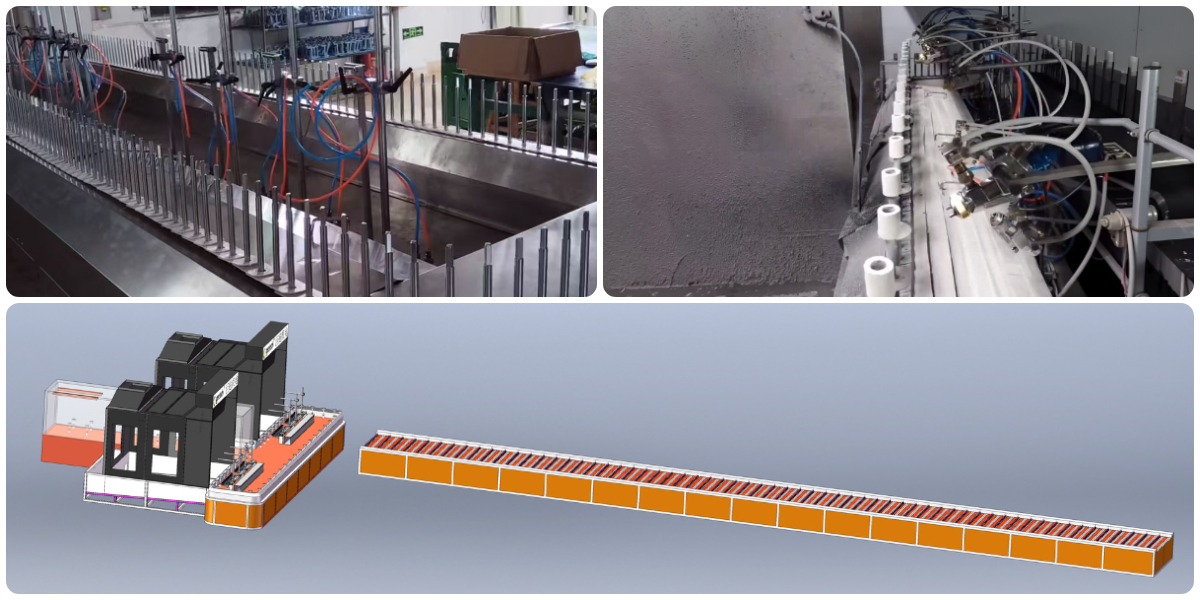
How a Ground Rail System Works
A floor mounted spray conveyor uses rails embedded in or laid on the workshop floor. Parts sit on fixtures attached to trolleys that travel along a closed loop or straight path. Operators load and unload at waist height, which keeps ergonomics simple and reduces fatigue during long shifts.
Because the entire system stays at floor level, you avoid the structural steel, catwalks, and high ceilings that overhead systems demand. A typical ground rail vs overhead spray line comparison shows the ground version needs only 3.2 to 3.5 meters of clear height versus 4.5 meters or more for悬挂式.
How an Overhead System Works
Overhead conveyors suspend parts from a chain that runs along beams near the ceiling. This keeps the floor clear for other operations and is popular in automotive body painting where parts are large and heavy. The chain, drive units, and tensioners all live above head level, requiring catwalks for maintenance.
For small parts—think door handles, cosmetic caps, LED housings—suspending each piece individually adds complexity. You need custom hanging jigs, and the part must be oriented just right to avoid uneven coating.
Space and Facility Comparison
Ground rail lines shine in compact workshops. An 8-station circular ground rail line can fit inside 14 square meters. The same capacity overhead system sprawls vertically and often requires a dedicated bay with reinforced roof structure.
Ceiling height is the deciding factor for many small factories. If your workshop is a standard industrial unit with 3 to 3.5 meters of height, a floor mounted spray conveyor is the only practical choice. Overhead systems simply will not fit without expensive building modifications.
Maintenance and Safety
Ground rail maintenance happens at floor level. Technicians can inspect chains, lubricate trolley wheels, and replace worn bearings without ladders or safety harnesses. This reduces downtime and keeps your maintenance costs predictable.
Overhead systems require technicians to climb to the ceiling for chain tension adjustments, lubricant application, and fault diagnosis. In dusty or paint-heavy environments, this elevated work also raises safety concerns.
Transfer Efficiency and Coating Quality
With ground rail, parts rotate on turntables as they pass spray guns, allowing 360-degree coverage without complex hanging geometry. This is especially valuable for small parts with multiple surfaces that all need paint.
Overhead systems can achieve good coverage too, but only if each part is hung at the correct angle. For high-mix production, this constant reorientation adds setup time and increases the chance of inconsistent film thickness.
Cost Breakdown
A ground rail system typically costs 20 to 35 percent less than an equivalent overhead line. You save on structural steel, catwalks, and the heavier chain drives needed to suspend loads. Installation is faster too—usually one week versus two or three for overhead.
Operating costs favor ground rail as well. Energy consumption is similar, but labor for maintenance and changeovers is lower because everything stays within easy reach.
When Overhead Is the Better Choice
Overhead conveyors still win for very large parts—full-size car doors, refrigerator panels, washing machine cabinets. Anything that is awkward to place on a floor-level fixture and benefits from hanging freely is a candidate for overhead transport.
If your product mix is dominated by small to medium parts, however, the ground rail approach delivers better ROI and simpler day-to-day operation.
Conclusion
For most海外采购商 running small parts production, the small parts spray painting line built on a ground rail foundation offers the best balance of cost, space efficiency, and coating quality. It keeps your operators safe, your maintenance simple, and your facility footprint compact.
Ready to evaluate which conveyor style fits your workshop? Contact our engineering team with your part dimensions and daily output targets—we will provide a customized layout and quotation.