

Introduction: Stations Define Capacity
When buyers ask about a small spray line station capacity, they are really asking two questions: how many parts can I paint per day, and how much space will it take? The number of stations—the stops along your ground rail loop—is the single biggest factor in answering both.
This guide compares the three most common configurations: 8, 12, and 16 stations.
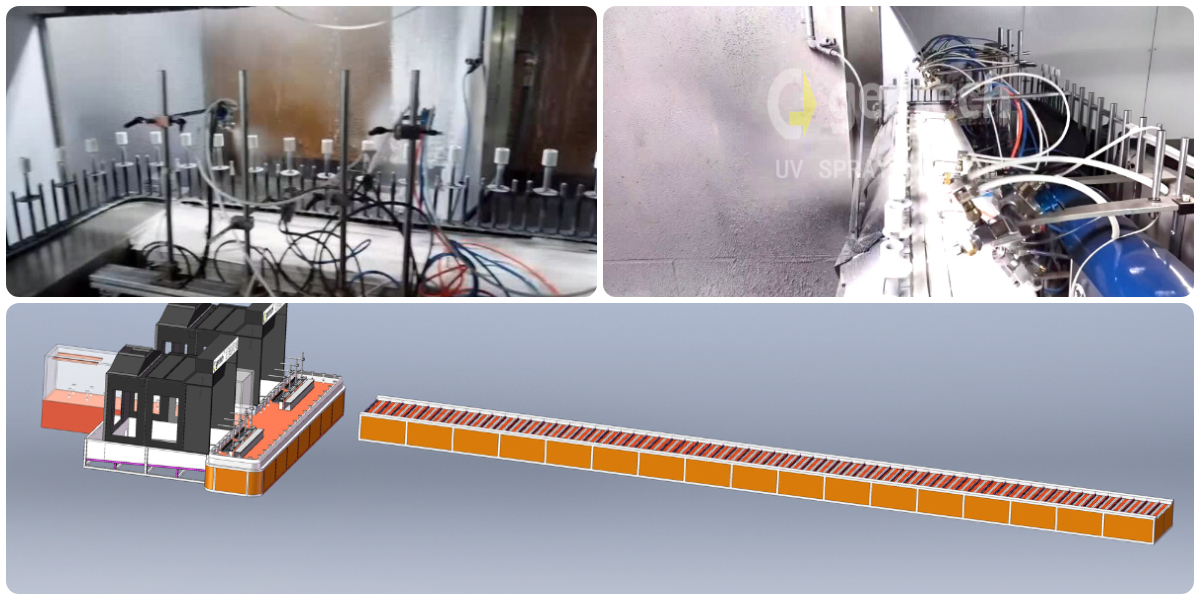
What Is a Station?
Each station is a position along the rail where a trolley stops (or passes through) to receive a specific process: loading, dust removal, spraying, curing, cooling, or unloading. More stations mean more process steps can happen simultaneously, increasing throughput.
Station spacing is typically 600 to 800 millimeters, depending on part size. This determines the overall diameter or length of your loop.
8-Station Line: The Compact Workhorse
The 8-station configuration is the entry point for most small workshops. It usually allocates stations as: 1 load, 1 dust removal, 2 spray, 1 flash-off, 2 cure, 1 unload. This provides a balanced flow for parts with moderate cure times.
Footprint is approximately 14 square meters with a 3.2-meter ceiling. Cycle time per part is typically 30 to 60 seconds, translating to daily output of roughly 800 to 1,500 parts per shift depending on part size and cure requirements.
12-Station Line: The Sweet Spot
Adding four more stations gives you room for a longer cure zone, an extra spray station for multi-color work, or a dedicated cooling section. The 12-station line is the most popular choice for growing businesses.
Footprint grows to about 22 to 25 square meters. With better process separation, cycle times drop and daily output climbs to approximately 1,500 to 2,500 parts per shift. Many buyers find this configuration offers the best balance of investment and capacity.
16-Station Line: High Throughput in a Loop
The 16-station line is for operations pushing toward 3,000+ parts per day. You can run multiple spray booths, extended cure zones, and even inline quality checks without bottlenecking the line.
Footprint is around 30 to 35 square meters. Daily output can reach 2,500 to 4,000 parts per shift. At this scale, many buyers add a second operator to handle loading and unloading simultaneously, further boosting efficiency.
Calculating Your Daily Capacity
A simple formula: Daily Output = (Number of Carts × Parts per Cart ÷ Cycle Time in Minutes) × 60 Minutes × 8 Hours × Efficiency Factor. The efficiency factor accounts for breaks, changeovers, and minor stoppages—typically 0.70 to 0.80 for well-run lines.
For example, an 8-station line with 8 carts, 1 part per cart, and a 45-second cycle: (8 × 1 ÷ 0.75) × 60 × 8 × 0.75 ≈ 3,840 parts per day. Adjust for your actual cycle time and parts-per-cart to get a realistic number.
Choosing the Right Number of Stations
Start by identifying your bottleneck process. If curing takes the longest, you need more oven stations. If spraying is the limit, add spray booths or upgrade to a robot for faster coverage.
Also consider future growth. It is often cheaper to buy a 12-station line now than to upgrade an 8-station line later. The rail, drive, and control system are easier to size up front.
When to Consider Two Lines Instead of One Big Line
Beyond 16 stations, a single loop becomes large and complex. At that point, two 8-station lines running in parallel may be more flexible. You can dedicate one to primer and one to topcoat, or run different products on each line.
This approach also provides redundancy—if one line needs maintenance, the other keeps production going.
Conclusion
Understanding 8 station spray painting line options and their larger siblings helps you match investment to actual demand. Start with your daily target, work backward through the capacity formula, and choose the station count that gives you 20 to 30 percent headroom for growth.
Send us your part dimensions and daily target—we will calculate the ideal station count and provide a detailed layout drawing.